
Be careful of hidden ego in good practices
Ego is the Greatest Barrier in Spiritual progress. Discover the real path to spiritual growth.

When we start following good practices, a subtle tendency often develops: the world is bad, and I am good because I do these things. This feeling comes automatically, but it is completely baseless.
Why?
We generalize too quickly. We have not seen anyone’s behavior deeply, yet we judge all people at once.
People change. A person’s behavior shifts with time. Can a single behavior truly define a person?
Our perception can be wrong. Just as a pencil looks bent in water due to illusion, our thoughts too can deceive us.
This feeling of superiority comes from a विकार (disorder) called मद (ego / अहंकार) i.e. the urge to praise ourselves and see ourselves as higher than others. Because we constantly compare ourselves with the world, we feel happy if we find even an imaginary reason to be above others.
But here lies the truth: no one really needs our help. We need to help ourselves. The real work is to see these Vikaars(विकार / disorder) within us and work hard to remove them. For this, rigorous naam jap (नाम जप) is essential.
As we progress in spiritual practice, the idea of “helping others” or “doing good for humanity” can sometimes become an excuse to display our ego. We must honestly check if our actions are guided by genuine need, or if they are just another way of feeding our ahankaar(ego / अहंकार).
Written by Sachin anand
More from this author
Bridging the Gap: Finding Ancient Wisdom in the Modern World
In today’s fast-paced environment, it is common to wake up surrounded by noise. From the moment the day begins, we are often met with endless notifica...

The Five Elements of Creation: Spiritual Insight Simplified
Hindu philosophy sees five basic elements: space, air, fire, water, and earth. The scriptures say everything began with space. Air then formed from sp...
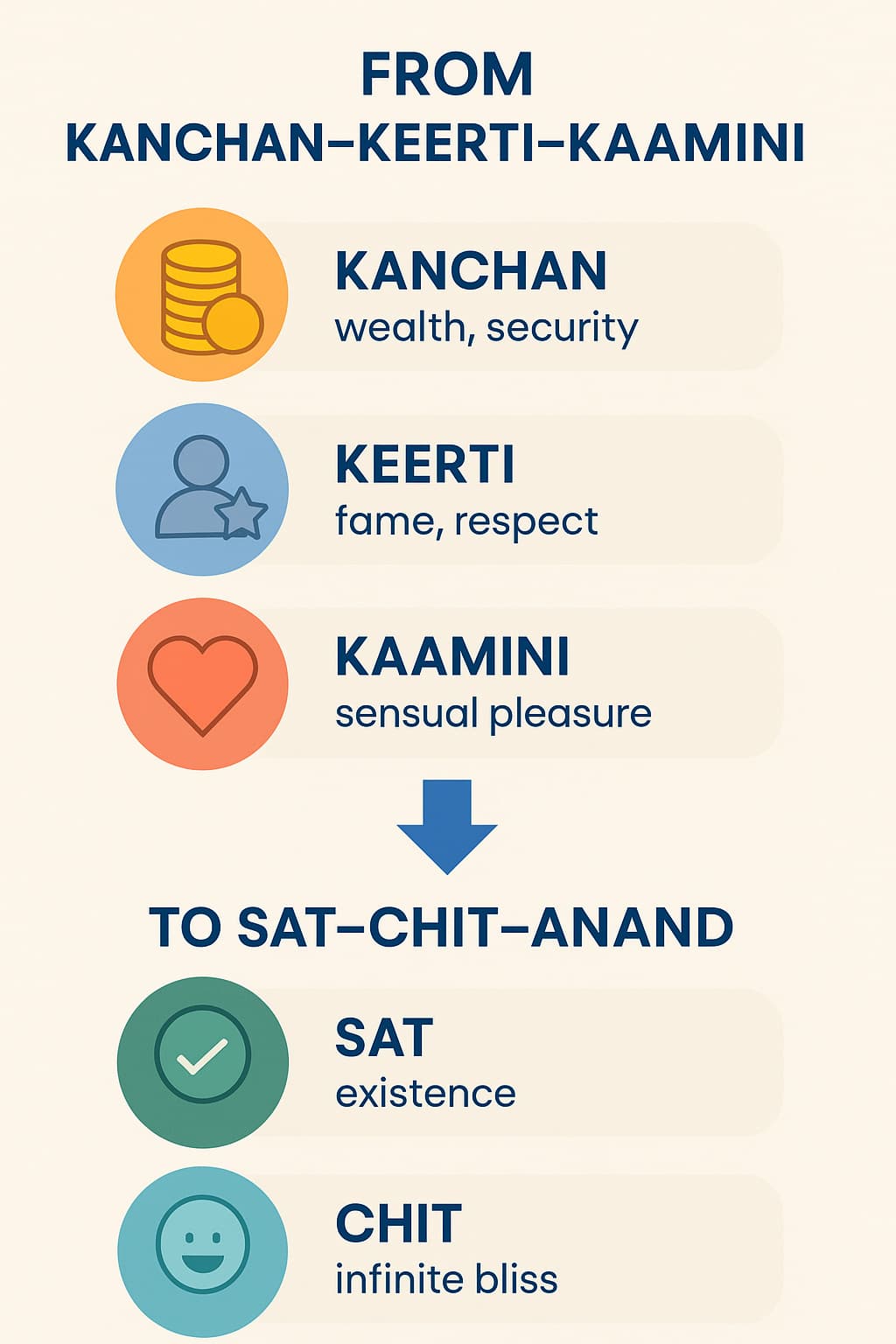
Kanchan, Keerti, Kaamini (KKK)
Every one of us lives with imperfect senses. We hear partially, see partially, perceive partially — and because of this incompleteness, we often fall ...